

Communicating Impact with Green SIM

The Interview with Chiara Pazzaglia and Filippo Diaco
Who is Chiara Pazzaglia?
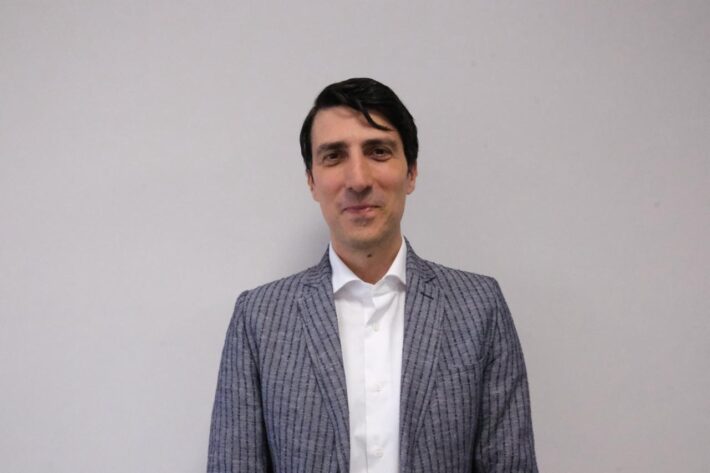
Chiara Pazzaglia is President of the provincial ACLI of Bologna, leading the Association since 2021. A journalist by profession, she collaborates with the daily newspaper Avvenire and directs L’Apricittà, the periodical of ACLI Bologna.
Who is Filippo Diaco?
Filippo Diaco is Deputy President of the provincial ACLI of Bologna and City Councilor for the Municipality of Bologna for the 2021-2026 administrative term, in which he was also appointed president of the Council Commission on sports, third sector, and volunteering.
Dr. Pazzaglia, Dr. Diaco, we thank you for accepting our invitation for the second time to come to Calabria to share your experience with the students of Green Social Impact Manager. What message did you choose to convey to the students?
CHIARA PAZZAGLIA Thank you for this opportunity. The students were incredibly attentive and engaged. We concluded the lesson with an exercise, where we asked them to find a word that represented what we had tried to leave them with today during this meeting. Beyond the more obvious “communication,” the most frequently written word was “responsibility.” We were very pleased, because it is a somewhat outdated word and it is not easy for such young people to be aware that the profession they have chosen to pursue through this course also entails social responsibilities toward the environment and toward future generations.
FILIPPO DIACO I also thank the Foundation; this is the second year that it has allowed us to meet these young people who are and will be our future. I must say that among the many words they wrote was also “We are needed.” This is precisely what our message in today’s session was meant to be: it is essential to involve as many people as possible in the life of the country, each with their own possibilities and abilities but above all with their own ideas. I saw a truly attentive class in which a real dialogue developed, in which constructive criticism was not lacking. We saw attention to their future, shared uncertainties and fears about what their approach to the world of work will be. In that “We are needed” we saw that these young people truly have the desire to get involved and to do something for others.
Together you brought your expertise and professionalism on the topic of communicating social impact. Today we communicate a great deal, but we do not always generate understanding: in your opinion, what is the difference between communicating and truly building meaning around a social project?
CHIARA PAZZAGLIA We focused heavily on this topic because we brought both positive and negative examples of good communication of green social impact. First of all, we tried to explain to the students that knowing how to communicate all aspects of social impact well is also a social responsibility we have toward the community in which we operate. Secondly, we tried to show them how any profession, even the most technical, can no longer do without good communication of what is being done. We brought negative examples as well from the institutions we represent and from some companies, cases in which certain aspects of communication and elements of active involvement of the people impacted by those project aspects were underestimated. Someone told me that they might be interested in working in communication, suggesting that perhaps this profession is destined to disappear in the age of artificial intelligence. I believe instead that on the contrary the profession of journalist, of the more serious communicator, will be needed all the more in a time when everyone doubts everything, because artificial intelligence easily produces fake news and instead our professionalism will be precisely synonymous with authority and, hopefully, authenticity.
FILIPPO DIACO I agree with Dr. Pazzaglia because I believe that communication is everything today, from small things to large projects. Alongside good communication there must also be good understanding, good planning, and for there to be good planning there needs to be that open dialogue with those who experience these things less in the territories. Today we talked about some specific projects, about the positive characteristics but also about the critical issues that arose, noting how through greater communication, more attentive, more targeted, a stronger and more positive impact is generated. The future of our country, the future of what surrounds us, must be built by various stakeholders: institutions cannot do everything alone, we need third sector organizations and we need the community, the citizens. If everyone, if citizens, third sector organizations, business associations, trade associations, and institutions dialogue with each other, then yes, an integrated project can be built, a social project that can respond to the needs of the territory.
This is not the first time you have taken part in the Social Impact Manager model courses; you were in fact part of the faculty of the very first SIM in spring 2025. What motivated you then to take part in a project still in its early stages and what instead motivated you to return to Calabria today?
CHIARA PAZZAGLIA Certainly the other time there was less awareness, but the evaluation of social impact is part of our respective professions. As president of an organization that works on high social impact projects, it has been essential for us to learn to communicate the social impact of our actions well and also to evaluate them; not only because it is required by certain projects, but also because it is important for us to realize the value that our action has in the world. We always try to accompany the financial statements of the organizations we represent with the social report, because it truly gives us the measure of everything that is not visible and quantifiable at an economic level, for example the weight that the work of volunteers, which is unpaid work, has on our activities or the fact that one euro spent on a service often produces three or four euros of value and no financial investment can do as much. It is this awareness that led us to welcome with great favor the idea of training social impact professionals, who would specifically deal with aspects such as evaluation that are still very underestimated in our world. We believe that SIM is a profession that is greatly needed. Furthermore, this year the more “green” shift directly involved Dr. Diaco who in his role as City Councilor is working extensively on the themes of green social impact on the choices of the municipal administration.
FILIPPO DIACO Why return here to the Foundation? Because I think that the young people who are enrolled and participating are the future of our country. They have the skills to do it, they simply need to be somehow accompanied with greater training. Today we said that life is a long obstacle course, we know this very well because we went through it ourselves before them. Students must not become demoralized, they must rather rediscover or develop that ability to start again at the first obstacle and I believe that the experience here in Filogaso can also be very useful for what will be their approach, for what will be their future, also through the experience of meeting various people from outside who come here to bring their experience. An aspect that further enriches their training. For us it is essential to create this constant relationship and above all to create this bond with those who have completed their studies. As for the work approach as well, we brought practical examples of entering the world of work. The wish I extend to them is that this may truly be the opportunity of their lives to train and be able to do something for others as well. We asked them not to stop only at “their own self,” what concerns their own well-being and their own livelihood, but to think of others as well, because we truly need to be able to do something for those who are left behind, for the many people today who are demoralized and stop at the first setback and do not know how to start again. I think that this training, these days, will certainly help students overcome the obstacle and rediscover their life project.
The free Advanced Training Course Green Social Impact Manager aims to create a new professional figure capable of designing and managing social impact for businesses, Public Administration, and the Third Sector. What do you think of this new professional figure?
CHIARA PAZZAGLIA In my opinion there is a great need for it. I believe that it is very useful for these young people to receive the testimonies of people who in their own professional field recognize the professional and social usefulness of this figure, of this profession. I believe that they do not yet fully realize, because they are at the beginning of their journey, that in institutions, in businesses, and in the third sector in particular there is a very great need for someone who knows how to recognize social impact and knows how to communicate it in the best way. I believe they will realize it, if they are able to present themselves well and if they know how to acquire awareness of the importance of their role, to spend this professionalism well in the labor market.
FILIPPO DIACO Everything that this experience gives them is certainly an increase for them in terms not only of skills, but above all of vision of the future and awareness of impact. We have seen it in some projects: impact not only environmental but also impact on sociality, on inclusion, on what concerns well-being, on everything that can concern making people feel good is fundamental and I think that figures like those being trained through the Augurusa Foundation course are very useful not only for institutions but also for profit and non-profit organizations: because they have that value that is missing today within our society. We need these figures and through the Foundation the opportunity is given to train, but above all to truly arrive within companies, institutions and therefore bring that added value that in the end allows you concretely to reach and understand the needs of the community, of citizens. We must walk together, we must interact even more, get involved: we all need it, because each one alone goes nowhere. We need to be able to build the future of our community together.